
Yo, what's up everyone! I'm part of a Brain Models supplier, and today we're gonna dive deep into the question: Are there open - source brain models available?
First off, let's understand what open - source means in this context. When we say open - source, we're talking about models whose source code, design, or underlying data is freely available. This allows researchers, students, and hobbyists to study, modify, and even redistribute it. It's a game - changer in the scientific community as it promotes collaboration and accelerates progress.
Now, the short answer is yes, there are open - source brain models out there. But it's not as straightforward as it sounds. The field of neuroscience is incredibly complex, and replicating the human brain, even in a simplified model, is no easy feat.
One of the most well - known open - source brain models is the Blue Brain Project. They've been working hard to create a digital reconstruction of the rodent brain at a cellular level. Their goal is to understand how the brain works by simulating its activity on supercomputers. The cool thing about this project is that they make a lot of their data and code publicly available. This means that other researchers can build on their work, test new hypotheses, and contribute to the overall understanding of the brain.
But here's the deal. While the Blue Brain Project is an amazing initiative, it has its limitations. The brain is an extremely dynamic and complex organ. There are billions of neurons, and they all interact in incredibly intricate ways. Current open - source models can only capture a fraction of this complexity. They often simplify things to make the simulations computationally feasible.
Another aspect to consider is the quality and accuracy of these open - source models. Just because something is open - source doesn't mean it's perfect. The data used to build these models might be incomplete or inaccurate. And since the brain is still a bit of a mystery, there's a lot of room for error in the assumptions made during the model - building process.
As a Brain Models supplier, we see the value in both open - source and proprietary models. Open - source models are great for educational purposes. Students can download them, tinker around, and get a better understanding of how the brain functions. They're also useful for researchers who want to do preliminary studies or test new ideas without having to start from scratch.
On the other hand, proprietary models often offer more advanced features and higher accuracy. We spend a lot of time and resources developing our models to ensure that they're as realistic as possible. Our models are used in a variety of settings, from medical schools for teaching anatomy to research institutions for in - depth studies.
For example, if you're looking for detailed Brain Model Parts, our models can provide a high - quality, accurate representation. These parts are essential for understanding the different structures of the brain and how they interact.
We also offer Vertebral Column Model and Anatomical Model Spine. These models are crucial for understanding the relationship between the brain and the rest of the nervous system. The spine acts as a highway for nerve signals, and having a good model can really help in visualizing this complex system.
So, if you're in the market for brain models, whether it's for educational, research, or other purposes, we've got you covered. We understand that different customers have different needs, and we're committed to providing the best possible products.

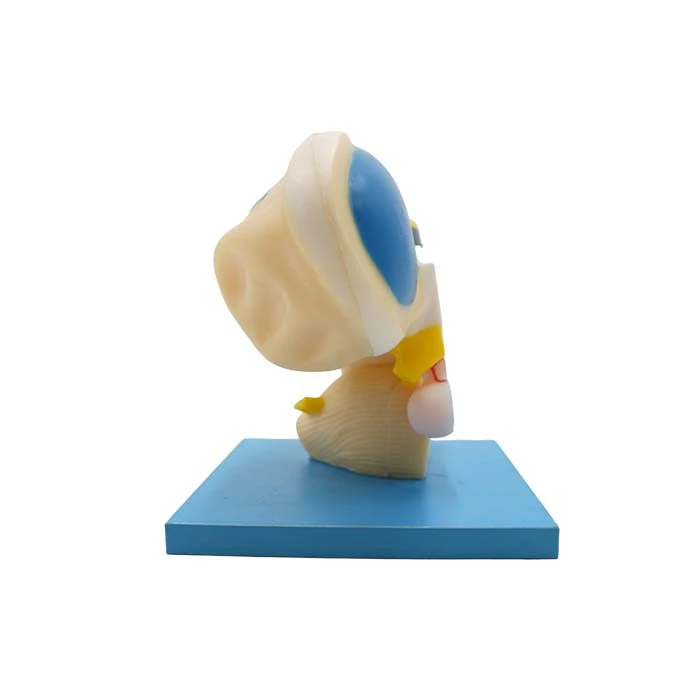
If you're interested in learning more about our brain models or want to discuss a potential purchase, don't hesitate to reach out. We're always happy to have a chat and see how we can meet your requirements. Whether you're a student, a researcher, or a medical professional, we believe our models can add value to your work.
In conclusion, open - source brain models are definitely available, and they play an important role in the field of neuroscience. They offer a great starting point for learning and collaboration. However, for more advanced and accurate applications, proprietary models like the ones we supply can be a better choice. So, take a look at what we have to offer, and let's start this exciting journey of exploring the brain together!
References
- Markram, H. (2006). The Blue Brain Project. Nature Reviews Neuroscience, 7(2), 153 - 160.
- Koch, C., & Segev, I. (Eds.). (2000). Methods in neuronal modeling: from ions to networks. MIT press.


