
Respiratory System
The respiratory system is a group of organs and structures in the body that enable breathing, primarily consisting of the nose, mouth, throat (pharynx), voice box (larynx), windpipe (trachea), bronchial tubes (bronchi), and lungs, which work together to take in oxygen from the air and expel carbon dioxide waste.
Why Choose Us
Our Product
The main products are plastination for human body and animal, body slices, human skeleton, embedment slices etc.
Product Application
Our software products cover classroom teaching, experimental teaching, and life science museum display system.
Production Market
Our products are widely recognized and trusted by users because of all hand-made preciously.
Our Factory
Meiwo Science is a large manufacturer appointed by National Ministry of Education and one of the large model producing factories in China, specialized in plastination technique, soft silicone anatomy models, soft silicone simulation models, embedded specimens, design and construction of life science museum, virtual simulation anatomy softwares and relative production.
-
![Throat Anatomy Model]()
Throat Anatomy Model
-
![Trachea Anatomy Model]()
Trachea Anatomy Model
-
![Anatomy Reference Model]()
Anatomy Reference Model
-
![Learning Resources Anatomy Models Bundle Set]()
Learning Resources Anatomy Models Bundle Set
-
![Anatomy And Physiology Models]()
Anatomy And Physiology Models
-
![Model Of Heart And Lungs]()
Model Of Heart And Lungs
-
![Respiratory Anatomy Model]()
Respiratory Anatomy Model
-
![Larynx Model Anatomy]()
Larynx Model Anatomy
-
![Heart Lung Model]()
Heart Lung Model
-
![Larynx And Trachea Model]()
Larynx And Trachea Model
-
![Human Lung Models]()
Human Lung Models
-
![Human Body Torso Model]()
Human Body Torso Model


Don't smoke. Smoking irritates your respiratory system and can make it harder to breathe. It raises your chances of COPD and lung cancer. Avoid secondhand smoke, too.
Exercise regularly, which will make your lungs and your heart stronger.
Stay hydrated. Water helps keep your mucus thin, which makes it easier to breathe. Thicker mucus can make you more likely to get an infection.
Get checkups, so you and your doctor can stay on top of any respiratory problems.
Get vaccinated. Vaccines can protect you against, COVID-19, the flu, RSV, and pneumonia. Talk to your doctor about which shots you should have. They're especially important if you have a respiratory condition.
Be aware of outdoor air pollution. Check the air quality where you are and follow recommendations to limit exposure when needed.
Promote good indoor air quality. Dusting regularly, changing your home's air filters, and keeping cigarette smoke out are a few ways to improve the air in your home.
Take deep breaths. This can improve your lung function, and it also may help you manage stress.
Wash your hands. It's one of the best ways to avoid the spread of upper respiratory infections.
Ask about a lung cancer screening. If you're at high risk, this test could make sense for you. Ask your doctor.
Anatomy of the Respiratory System


Nose and Nasal Cavity
The nose and nasal cavity form the main external opening for the respiratory system and are the first section of the body's airway---the respiratory tract through which air moves. The nose is a structure of the face made of cartilage, bone, muscle, and skin that supports and protects the anterior portion of the nasal cavity. The nasal cavity is a hollow space within the nose and skull that is lined with hairs and mucus membrane. The function of the nasal cavity is to warm, moisturize, and filter air entering the body before it reaches the lungs. Hairs and mucus lining the nasal cavity help to trap dust, mold, pollen and other environmental contaminants before they can reach the inner portions of the body. Air exiting the body through the nose returns moisture and heat to the nasal cavity before being exhaled into the environment.
Mouth
The mouth, also known as the oral cavity, is the secondary external opening for the respiratory tract. Most normal breathing takes place through the nasal cavity, but the oral cavity can be used to supplement or replace the nasal cavity's functions when needed. Because the pathway of air entering the body from the mouth is shorter than the pathway for air entering from the nose, the mouth does not warm and moisturize the air entering the lungs as well as the nose performs this function. The mouth also lacks the hairs and sticky mucus that filter air passing through the nasal cavity. The one advantage of breathing through the mouth is that its shorter distance and larger diameter allows more air to quickly enter the body.
Pharynx
The pharynx, also known as the throat, is a muscular funnel that extends from the posterior end of the nasal cavity to the superior end of the esophagus and larynx. The pharynx is divided into 3 regions: the nasopharynx, oropharynx, and laryngopharynx. The nasopharynx is the superior region of the pharynx found in the posterior of the nasal cavity. Inhaled air from the nasal cavity passes into the nasopharynx and descends through the oropharynx, located in the posterior of the oral cavity. Air inhaled through the oral cavity enters the pharynx at the oropharynx. The inhaled air then descends into the laryngopharynx, where it is diverted into the opening of the larynx by the epiglottis. The epiglottis is a flap of elastic cartilage that acts as a switch between the trachea and the esophagus. Because the pharynx is also used to swallow food, the epiglottis ensures that air passes into the trachea by covering the opening to the esophagus. During the process of swallowing, the epiglottis moves to cover the trachea to ensure that food enters the esophagus and to prevent choking.
Larynx
The larynx, also known as the voice box, is a short section of the airway that connects the laryngopharynx and the trachea. The larynx is located in the anterior portion of the neck, just inferior to the hyoid bone and superior to the trachea. Several cartilage structures make up the larynx and give it its structure. The epiglottis is one of the cartilage pieces of the larynx and serves as the cover of the larynx during swallowing. Inferior to the epiglottis is the thyroid cartilage, which is often referred to as the Adam's apple as it is most commonly enlarged and visible in adult males. The thyroid holds open the anterior end of the larynx and protects the vocal folds. Inferior to the thyroid cartilage is the ring-shaped cricoid cartilage which holds the larynx open and supports its posterior end. In addition to cartilage, the larynx contains special structures known as vocal folds, which allow the body to produce the sounds of speech and singing. The vocal folds are folds of mucous membrane that vibrate to produce vocal sounds. The tension and vibration speed of the vocal folds can be changed to change the pitch that they produce.
Trachea
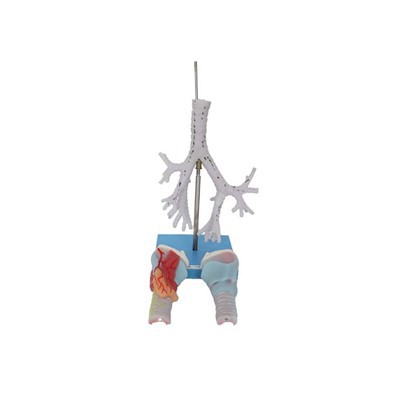
The trachea, or windpipe, is a 5-inch long tube made of C-shaped hyaline cartilage rings lined with pseudostratified ciliated columnar epithelium. The trachea connects the larynx to the bronchi and allows air to pass through the neck and into the thorax. The rings of cartilage making up the trachea allow it to remain open to air at all times. The open end of the cartilage rings faces posteriorly toward the esophagus, allowing the esophagus to expand into the space occupied by the trachea to accommodate masses of food moving through the esophagus.
Bronchi and Bronchioles
At the inferior end of the trachea, the airway splits into left and right branches known as the primary bronchi. The left and right bronchi run into each lung before branching off into smaller secondary bronchi. The secondary bronchi carry air into the lobes of the lungs---2 in the left lung and 3 in the right lung. The secondary bronchi in turn split into many smaller tertiary bronchi within each lobe.
Lungs
The lungs are a pair of large, spongy organs found in the thorax lateral to the heart and superior to the diaphragm. Each lung is surrounded by a pleural membrane that provides the lung with space to expand as well as a negative pressure space relative to the body's exterior. The negative pressure allows the lungs to passively fill with air as they relax. The left and right lungs are slightly different in size and shape due to the heart pointing to the left side of the body. The left lung is therefore slightly smaller than the right lung and is made up of 2 lobes while the right lung has 3 lobes.
Muscles of Respiration
Surrounding the lungs are sets of muscles that are able to cause air to be inhaled or exhaled from the lungs. The principal muscle of respiration in the human body is the diaphragm, a thin sheet of skeletal muscle that forms the floor of the thorax. When the diaphragm contracts, it moves inferiorly a few inches into the abdominal cavity, expanding the space within the thoracic cavity and pulling air into the lungs. Relaxation of the diaphragm allows air to flow back out the lungs during exhalation.
Top 5 Functions of the Respiratory System
Inhalation and Exhalation Are Pulmonary Ventilation—That’s Breathing
The respiratory system aids in breathing, also called pulmonary ventilation. In pulmonary ventilation, air is inhaled through the nasal and oral cavities (the nose and mouth). It moves through the pharynx, larynx, and trachea into the lungs. Then air is exhaled, flowing back through the same pathway. Changes to the volume and air pressure in the lungs trigger pulmonary ventilation. During normal inhalation, the diaphragm and external intercostal muscles contract and the ribcage elevates. As the volume of the lungs increases, air pressure drops and air rushes in. During normal exhalation, the muscles relax. The lungs become smaller, the air pressure rises, and air is expelled.
External Respiration Exchanges Gases Between the Lungs and the Bloodstream
Inside the lungs, oxygen is exchanged for carbon dioxide waste through the process called external respiration. This respiratory process takes place through hundreds of millions of microscopic sacs called alveoli. Oxygen from inhaled air diffuses from the alveoli into pulmonary capillaries surrounding them. It binds to hemoglobin molecules in red blood cells, and is pumped through the bloodstream. Meanwhile, carbon dioxide from deoxygenated blood diffuses from the capillaries into the alveoli, and is expelled through exhalation.
Internal Respiration Exchanges Gases Between the Bloodstream and Body Tissues
The bloodstream delivers oxygen to cells and removes waste carbon dioxide through internal respiration, another key function of the respiratory system. In this respiratory process, red blood cells carry oxygen absorbed from the lungs around the body, through the vasculature. When oxygenated blood reaches the narrow capillaries, the red blood cells release the oxygen. It diffuses through the capillary walls into body tissues. Meanwhile, carbon dioxide diffuses from the tissues into red blood cells and plasma. The deoxygenated blood carries the carbon dioxide back to the lungs for release.
Air Vibrating the Vocal Cords Creates Sound
Phonation is the creation of sound by structures in the upper respiratory tract of the respiratory system. During exhalation, air passes from the lungs through the larynx, or “voice box.” When we speak, muscles in the larynx move the arytenoid cartilages. The arytenoid cartilages push the vocal cords, or vocal folds, together. When the cords are pushed together, air passing between them makes them vibrate, creating sound. Greater tension in the vocal cords creates more rapid vibrations and higher-pitched sounds. Lesser tension causes slower vibration and a lower pitch.
Olfaction, or Smelling, Is a Chemical Sensation
The process of olfaction begins with olfactory fibers that line the nasal cavities inside the nose. As air enters the cavities, some chemicals in the air bind to and activate nervous system receptors on the cilia. This stimulus sends a signal to the brain: neurons take the signal from the nasal cavities through openings in the ethmoid bone, and then to the olfactory bulbs. The signal then travels from the olfactory bulbs, along cranial nerve 1, to the olfactory area of the cerebral cortex.
Physiology Of The Respiratory System
Pulmonary Ventilation
Pulmonary ventilation is the process of moving air into and out of the lungs to facilitate gas exchange. The respiratory system uses both a negative pressure system and the contraction of muscles to achieve pulmonary ventilation. The negative pressure system of the respiratory system involves the establishment of a negative pressure gradient between the alveoli and the external atmosphere. The pleural membrane seals the lungs and maintains the lungs at a pressure slightly below that of the atmosphere when the lungs are at rest. This results in air following the pressure gradient and passively filling the lungs at rest. As the lungs fill with air, the pressure within the lungs rises until it matches the atmospheric pressure. At this point, more air can be inhaled by the contraction of the diaphragm and the external intercostal muscles, increasing the volume of the thorax and reducing the pressure of the lungs below that of the atmosphere again.
External Respiration
External respiration is the exchange of gases between the air filling the alveoli and the blood in the capillaries surrounding the walls of the alveoli. Air entering the lungs from the atmosphere has a higher partial pressure of oxygen and a lower partial pressure of carbon dioxide than does the blood in the capillaries. The difference in partial pressures causes the gases to diffuse passively along their pressure gradients from high to low pressure through the simple squamous epithelium lining of the alveoli. The net result of external respiration is the movement of oxygen from the air into the blood and the movement of carbon dioxide from the blood into the air. The oxygen can then be transported to the body's tissues while carbon dioxide is released into the atmosphere during exhalation.
Internal Respiration
Internal respiration is the exchange of gases between the blood in capillaries and the tissues of the body. Capillary blood has a higher partial pressure of oxygen and a lower partial pressure of carbon dioxide than the tissues through which it passes. The difference in partial pressures leads to the diffusion of gases along their pressure gradients from high to low pressure through the endothelium lining of the capillaries. The net result of internal respiration is the diffusion of oxygen into the tissues and the diffusion of carbon dioxide into the blood.
Transportation of Gases
The 2 major respiratory gases, oxygen and carbon dioxide, are transported through the body in the blood. Blood plasma has the ability to transport some dissolved oxygen and carbon dioxide, but most of the gases transported in the blood are bonded to transport molecules. Hemoglobin is an important transport molecule found in red blood cells that carries almost 99% of the oxygen in the blood. Hemoglobin can also carry a small amount of carbon dioxide from the tissues back to the lungs. However, the vast majority of carbon dioxide is carried in the plasma as bicarbonate ion. When the partial pressure of carbon dioxide is high in the tissues, the enzyme carbonic anhydrase catalyzes a reaction between carbon dioxide and water to form carbonic acid. Carbonic acid then dissociates into hydrogen ion and bicarbonate ion. When the partial pressure of carbon dioxide is low in the lungs, the reactions reverse and carbon dioxide is liberated into the lungs to be exhaled.
Homeostatic Control of Respiration
Under normal resting conditions, the body maintains a quiet breathing rate and depth called eupnea. Eupnea is maintained until the body's demand for oxygen and production of carbon dioxide rises due to greater exertion. Autonomic chemoreceptors in the body monitor the partial pressures of oxygen and carbon dioxide in the blood and send signals to the respiratory center of the brain stem. The respiratory center then adjusts the rate and depth of breathing to return the blood to its normal levels of gas partial pressures.
Our Factory
Meiwo science software products cover classroom teaching, experimental teaching, and life science museum display system. Specifically, there are multiple sets of medical software such as comprehensive teaching platform for human anatomy, digital human anatomy system, 3D specimen database query system, human body nine interactive display system, VR human anatomy, and assembly of human organs, etc.
Meiwo adopts the construction concept of "intelligent life science museum", which integrates the intelligent management of the exhibition hall, the professional display of specimens and the scientific display of medical knowledge.The exhibition hall will provide a high-tech, intelligent and experiential interactive learning platform with the combination of human experimental teaching, popular science education, clinical application, humanistic care, cultural inheritance, medicine and art, etc.

FAQ
Q: What is the basic definition of the respiratory system?
Q: What is the function of the respiratory system?
Q: What are the 7 main parts of the respiratory system?
Nose.
Mouth.
Throat (pharynx)
Voice box (larynx)
Windpipe (trachea)
Airways (bronchi)
Lungs.
Q: What is the main organ of the respiratory system?
Your lungs are on each side of your heart, inside your chest cavity. They are the main organs of the respiratory system.
Q: What is the process of the respiratory system?
Q: How do you repair your respiratory system?
Q: Why is the respiratory system good?
Q: How is respiratory system helpful to us?
Q: What are the three importance of the respiratory system?
Q: What are the advantages of respiratory system?
We're well-known as one of the leading respiratory system manufacturers and suppliers in China, specialized in providing various animal & human body specimens. Welcome to buy high quality respiratory system for sale here from our factory. animal skulls for sale cheap, real animals skeleton, Plastination Rabbit