
Locomotor System
The locomotor system, also known as the musculoskeletal system, includes all the anatomical structures that work together to facilitate movement. This system is divided into two main parts: the skeletal system and the muscular system. The skeletal system provides the structural framework and protection for the body's organs, while the muscular system generates movement by contracting.
Why Choose Us
Our Product
The main products are plastination for human body and animal, body slices, human skeleton, embedment slices etc.
Product Application
Our software products cover classroom teaching, experimental teaching, and life science museum display system.
Production Market
Our products are widely recognized and trusted by users because of all hand-made preciously.
Our Factory
Meiwo Science is a large manufacturer appointed by National Ministry of Education and one of the large model producing factories in China, specialized in plastination technique, soft silicone anatomy models, soft silicone simulation models, embedded specimens, design and construction of life science museum, virtual simulation anatomy softwares and relative production.
-
![Meiwo Hand Anatomy Model With Muscles]()
Meiwo Hand Anatomy Model With Muscles
-
![Human Muscles Of Lower Limb Anatomy Model]()
Human Muscles Of Lower Limb Anatomy Model
-
![Silicone Legs Model]()
Silicone Legs Model
-
![Human Body Muscle Model]()
Human Body Muscle Model
-
![Facial Muscle Anatomy Model]()
Facial Muscle Anatomy Model
-
![Thigh Muscle Model]()
Thigh Muscle Model
-
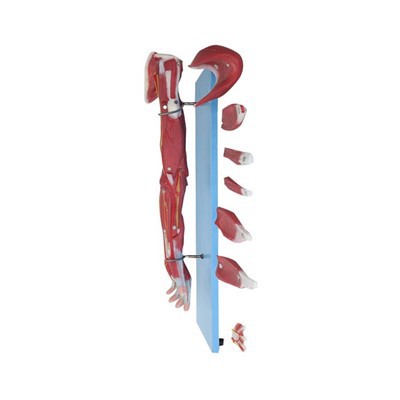
![Arm Muscle Anatomy Model]()
Arm Muscle Anatomy Model
-
![Forearm Muscle Model]()
Forearm Muscle Model
-
![Head Muscle Model]()
Head Muscle Model
-
![Plastic Anatomical Models]()
Plastic Anatomical Models
-
![Human Body Model Making]()
Human Body Model Making
-
![Science Model Human Body]()
Science Model Human Body


Parts Of The Locomotor System
Bones
The bones are the main structure of the musculoskeletal system. They are responsible for providing support and protection to internal organs, and also act as levers to facilitate movement. The human body has 206 bones in total, which are divided into two groups: axial bones (skull, spine, ribs, etc.) and appendicular bones (upper and lower extremities).
Joints
Joints are the unions between two or more bones. They allow movement and flexibility of the body, acting as joining points between the different bone segments. There are different types of joints in the human body, such as mobile joints (such as the hip or shoulder), semi-mobile joints (such as the vertebrae) and immobile joints (such as those of the skull).
Muscles
Muscles are responsible for producing movement in the body. There are three types of muscles: skeletal muscles (control voluntary movement), smooth muscles (control the involuntary movement of internal organs) and cardiac muscle (forms the walls of the heart and is responsible for its contraction). Skeletal muscles are those that are attached to the bones and allow us to move.
Functions Of The Locomotor System
The main function of the muscular system is to produce movement of the body. Depending on the axis and plane, there are several different types of movements that can be performed by the musculoskeletal system. Some of the most important ones include:
Flexion and extension: Movement of decreasing or increasing the angle between the bones involved in the movement, respectively. This motion takes place in the sagittal plane around a frontal axis. An example of flexion is bending the leg at the knee joint, whereas extension would be straightening knee from a flexed position.
Adduction and abduction: Movements of bringing the parts of the body towards or away from the midline, respectively. These movements are carried out in the frontal plane around a sagittal axis. For example, abduction of the arm at the shoulder joint involves moving the arm away from the side of the body, while adduction involves bringing it back towards the body.
Rotation is the movement in which a part of the body rotates around its vertical (longitudinal) axis in the transverse plane. This movement is defined relative to the midline, where internal rotation involves rotating the segment towards to the midline, while external rotation involves moving it away from the midline. Examples include lateral or medial rotation of the thigh.
Supination and pronation are special types of rotatory movements usually used to describe the movements of the forearm. Supination is essentially a lateral rotation of the forearm which turns the palms anteriorly (if the arm is anatomical position) or superiorly, when the elbow is flexed. These movements are also sometimes used to describe movements in the ankle and foot, in which supination means rolling the foot outwards, while pronation means rolling the foot inwards.
Characteristics of the Locomotor System
Flexibility
The musculoskeletal system is capable of adapting to different movements and positions, thanks to the flexibility of the joints and muscles. This ability to flex and extend allows us to perform a wide variety of physical activities, from walking and running to more demanding sports.
Endurance
The musculoskeletal system is also characterized by its resistance, which is the ability to maintain physical effort for a long time. Muscles are strengthened with regular exercise, which improves endurance and reduces muscle fatigue during physical activity.
Coordination
Coordination between the different components of the musculoskeletal system is essential to perform precise and efficient movements. The brain, muscles and joints work together to achieve adequate motor coordination, which is developed throughout life through practice and training.
Stability
The stability of the musculoskeletal system is related to the ability to maintain balance and posture in different situations. The core muscles (the abdominal and lumbar area) are key to maintaining the stability of the body, avoiding injuries and facilitating safe movement.
Elasticity
Elasticity is the property that allows muscles and connective tissues to stretch and return to their original length. Adequate elasticity is important to prevent muscle injuries and maintain joint mobility in its full range.
The Functioning And Adaptability Of The Locomotor System



We strive to maintain the various parameters of our organism in different domains, so ensuring our survival. If we go beyond the usual parameter ranges, an adaptation response begins. If the displacement is too fast and/or powerful and is not followed by a rapid recovery, the individual will be in a state of shock and, without help, may lose his or her life. However, if we move out of the optimum ranges gradually, in small steps, and we exercise in this way regularly and enough times, we may be surprised at what extreme conditions we will be able to tolerate.
Basics of muscle function
Muscle is the main structure for locomotion of the animal-type life form on earth. The smallest muscle in the animal world is less than one millimetre long (microscopic crustaceans), while the longest ones are in the meter range (whales’ muscles). This is roughly a hundred thousand-fold difference in length, and about a quadrillion-fold (million billion, i.e. 1015) in volume (Vogel 2013).
The skeletal muscle fibres are formed by the fusion of several cells, so they contain several nuclei, which are located on the periphery of the cells, similar to the large number of mitochondria that produce energy (in the form of ATP). Almost the entire interior of the cell is filled with bundles of actin-myosin molecules.
Biomechanical peculiarities of muscle tissue
Contraction
Although we usually talk about contraction when dealing with muscle work, the muscle is never literally contracted. The actin and myosin filaments do not contract, but when examined at the macroscopic level, the muscle does not contract either.
Tendons
The muscles are thus connected to the bones by the tendons. The tendon is a structure formed by the so-called dense connective tissue in which collagen fibres of great flexibility and tensile strength run in parallel. Collagen is a protein molecule that consists of fibres running in a triple helix structure, and is a universal connective tissue component in the human (and generally in the mammal) body. We can find it in the skin, muscles, bones, cartilage, tendons, and ligaments, but also in the cornea of the eye, in the walls of the blood vessels, or in the dentine substance of the teeth.
Muscle and power
It is no accident that the muscle is such a widely used structure in the animal world: in terms of output, the muscle is the absolute biological champion among multicellular organisms with its maximum average value of 200 watts/kilogram (the second, the eukaryotic cilium is far behind, at about 30 watts/kg; Vogel 2013). However, this value is far from its real performance; neither the muscle, and even less a whole human being, can produce this much output, but only a fraction – in fact, less than a tenth. Therefore, it can be said that the power delivered is not limited by the capabilities of actomyosin bundles, but by other features of the system operation, such as the nutrient and oxygen supply of the muscles, and the constraints of heat loss.
The Following Are Clinical Conditions Of The Locomotor System
Osteoporosis
Osteoporosis is a condition that affects bone strength (the word osteoporosis literally means "porous bones"). It is a condition in which the bones become fragile and brittle, leading to a higher risk of fractures than in normal bone. As a result, even a minor bump or accident can cause serious fractures.
Osteoporosis is the “bone of the old”, especially, in women. The hard, rock-like quality of bone is dependent upon calcium. When too much calcium is dissolved from bones or not enough is replaced, bones lose density and are easily fractured. Estrogen, the female sex hormone, helps maintain proper calcium levels in bones. Once the ovaries stop producing the hormone, women are at higher risk of developing osteoporosis. A collapse of bony vertebrae of the spinal column results in loss of height and stooped posture. Hip fractures are a common occurrence.
Sarcopenia
Sarcopenia is a syndrome characterized by progressive and generalized loss of skeletal muscle mass and strength with a risk of adverse outcomes such as physical disability, poor quality of life and death.
Arthritis
Arthritis is a group of conditions affecting the joints. These conditions cause damage to the joints, usually resulting in pain and stiffness due to aging. Arthritis can affect many different parts of the joint and nearly every joint in the body.
As an individual ages, the joint tissues become less resilient to wear and tear and start to degenerate. This degeneration manifest as swelling, pain, and often-times, loss of mobility of joints. Changes occur in both joint soft tissues and the articulating bones, a condition called osteoarthritis. A more serious form of disease is called rheumatoid arthritis. The latter is an autoimmune disease wherein the body produces antibodies against joint tissues causing chronic inflammation resulting in severe joint damage, pain and immobility.
Muscular dystrophy
Muscular dystrophy is a group of muscle diseases that weaken the musculoskeletal system and hamper locomotion. Muscular dystrophies are characterized by progressive skeletal muscle weakness, defects in muscle proteins, and the death of muscle fibres (muscle cells) and tissue.
It is a group of inherited diseases in which the muscles that control movement progressively weaken. The prefix, dys-, means abnormal, while the root, refers to maintaining normal nourishment, structure and function. The most common form in children is called Duchenne muscular dystrophy and affects only males. It usually appears between the ages of 2 to 6 and the afflicted live typically into late teens to early 20s.
Our Factory
Meiwo science software products cover classroom teaching, experimental teaching, and life science museum display system. Specifically, there are multiple sets of medical software such as comprehensive teaching platform for human anatomy, digital human anatomy system, 3D specimen database query system, human body nine interactive display system, VR human anatomy, and assembly of human organs, etc.
Meiwo adopts the construction concept of "intelligent life science museum", which integrates the intelligent management of the exhibition hall, the professional display of specimens and the scientific display of medical knowledge.The exhibition hall will provide a high-tech, intelligent and experiential interactive learning platform with the combination of human experimental teaching, popular science education, clinical application, humanistic care, cultural inheritance, medicine and art, etc.

FAQ
Q: What is the meaning of locomotor system?
The musculoskeletal system is also called the locomotor system. It is composed of a skeleton, skeletal muscle, ligaments, tendons, cartilage, joints, and other connective tissue. These parts perform together to move your body.
Q: What is the locomotion of a human?
Q: What is locomotor body movement?
Q: What two systems are included in the locomotor system?
Q: What are locomotor system disorders?
Q: What is the locomotor activity of humans?
Q: Which two body systems are responsible for locomotion?
Q: Which two body systems are mostly responsible for movement?
Q: What organs are in the locomotion system?
Q: Why is locomotion important?
Q: What is the active part of the locomotor system?
Q: How to improve locomotor skills?
Q: Which 3 body systems are involved in movement?
Q: What are 20 locomotor skills?
Q: What is another name for the locomotor system?
Q: What is the active part of the locomotor system?
Q: What are the locomotor skills?
Q: What is locomotor activity in humans?
Q: What are the benefits of locomotor exercise?
Q: Which two body systems are mostly responsible for movement?
We're well-known as one of the leading locomotor system manufacturers and suppliers in China, specialized in providing various animal & human body specimens. Welcome to buy high quality locomotor system for sale here from our factory. plastinated animal organ, Glomerulus Soft Silicone Anatomy Model specimens, Male Reproductive Organ Soft Silicone Anatomy Model